No-Code vs. Low-Code vs. Custom Code: How Early-Stage Startups Should Choose Their First Tech Stack
Early-stage founders have to decide how to build their first product. The choice between no-code, low-code and custom code affects how fast the business can launch and how easily it can grow
Early-stage founders have to decide how to build their first product. The choice between no-code, low-code and custom code affects how fast the business can launch and how easily it can grow later. A poor choice can waste money and leave you with a system that struggles once real customers arrive. This post compares the three options and gives you questions to help choose a startup tech stack that fits your stage.
No-code for rapid testing
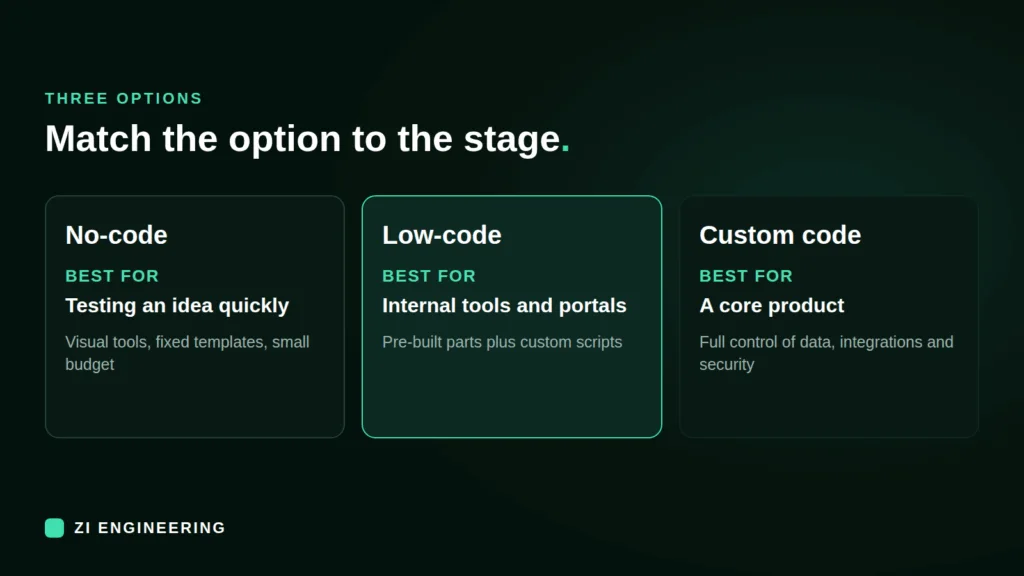
No-code platforms use visual, drag-and-drop tools to build applications without writing software. They suit a startup that wants to test an idea quickly on a small budget. A non-technical founder can often put together a simple booking or listing tool in a short time and see whether customers are interested.
The limit is flexibility. No-code tools rely on fixed templates and features. If the business needs a unique feature or complex data processing, the platform may not support it. Some startups outgrow no-code once they need to manage larger numbers of users securely.
The low-code middle ground
Low-code platforms give you pre-built components and let developers add custom scripts to connect them. This sits between speed and flexibility. A startup could use low-code for an internal sales dashboard or a customer portal that connects to an existing database.
A low-code startup tech stack still needs technical knowledge to use well. The startup also depends on the platform provider. If the vendor changes its pricing or removes a feature, the business has to adapt to that decision.
Custom code for long-term ownership
Custom development means writing the application from scratch. The startup can design the database, build specific integrations and set strict security rules. It can also own the code, if the contract says so.
The trade-off for a custom startup tech stack is time and cost. Custom software takes longer and needs a larger upfront investment. It tends to fit best when the technology is the core of the business, for example a product with advanced AI features, deep integrations with enterprise software, or a very specific user interface.
An example: a tutor booking marketplace
Imagine a founder who wants to build a marketplace where students book local tutors. In the first month, the founder builds a no-code version with a listing page and a booking form, to learn whether tutors and students will use it. That version is a test, not the final product. The first startup tech stack in this example was chosen to learn, not to last.
Once people start using it, the needs become clearer: online payments, tutor verification, reminders and reports that the platform handles poorly. Those needs point towards a custom build, and the founder can use what was learned to decide which features to keep. This is an illustration, not a real customer. Our feature cutting playbook covers how to decide what goes into a first version.
Questions to ask before you choose a startup tech stack
These questions can help you compare the options:
- What are you trying to learn, and how soon do you need to learn it?
- If the platform raises prices or closes, can you export your data and users?
- How sensitive is the data, and who is responsible for security?
- Who will maintain the product: a founder, a hired developer or an outside team?
- Do you need integrations or AI features that the platform does not offer?
A startup tech stack does not have to be permanent. Many founders start light and move later, as long as they plan how to move their data and users. Our MVP tech stack selection scorecard goes deeper on this decision, and our guide to MVP development budgets can help you plan the cost.
Building with Zimozi
Zimozi builds custom web and mobile applications, SaaS products, and AI agents with workflow automation. We also connect new tools to existing systems through system integrations. For fintech and digital products, that can include a secure platform with the integrations it needs. We help founders think through their startup tech stack and shape affordable MVP development around one clearly defined use case, so a working version reaches the market sooner. Our post on why MVP development is important for startups explains the thinking behind this approach.
If you are considering a similar application, Zimozi can help define a small first version and assess the technical requirements. Would you like to discuss the idea?