The Feature Cutting Playbook: How Pre Seed Founders Decide What Stays and What Goes in a First Release
When founders plan a new software product, they naturally picture the finished vision. They imagine rich user profiles, automated notifications, referral programs, multiple payment options,
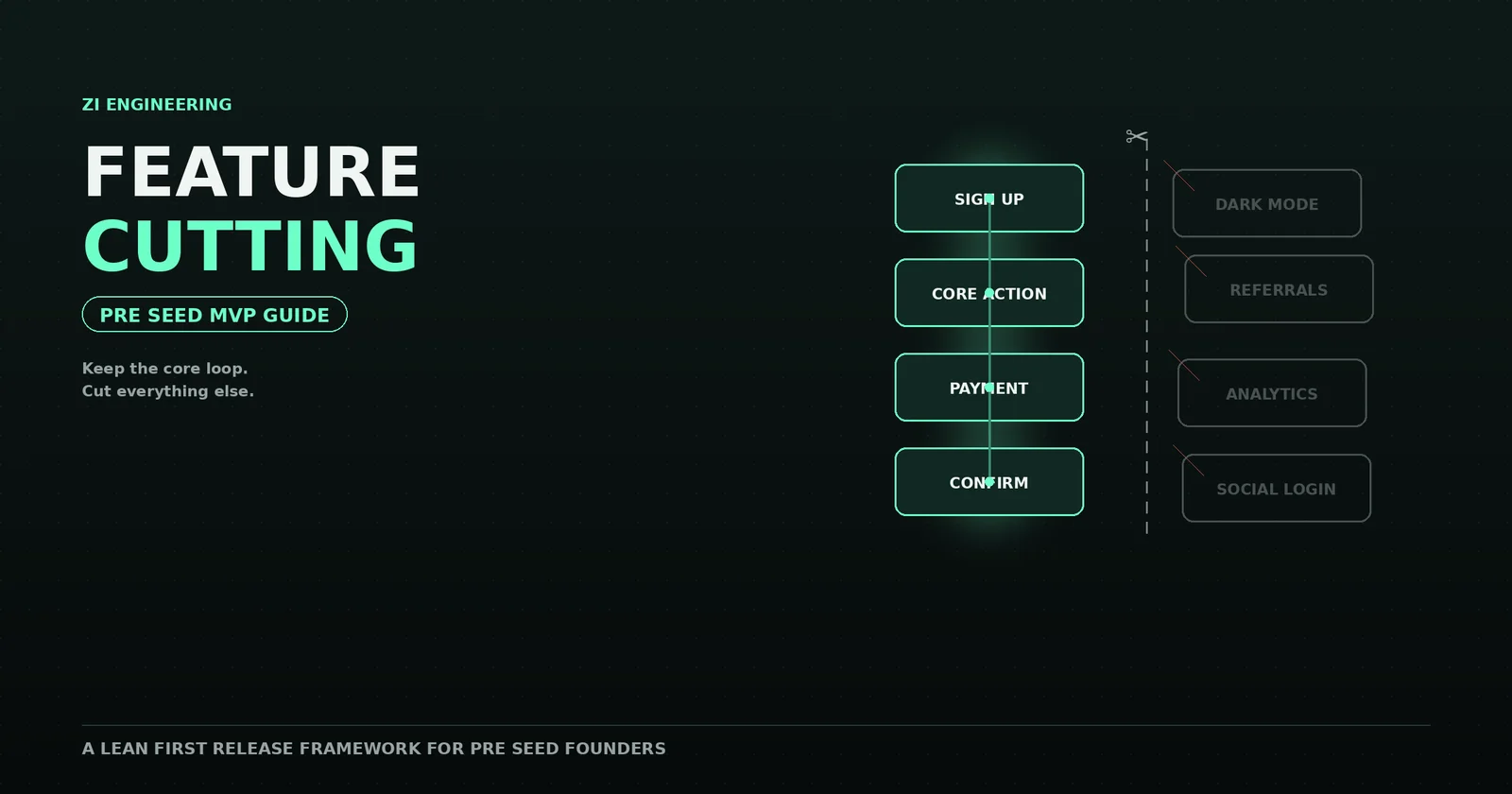
When founders plan a new software product, they naturally picture the finished vision. They imagine rich user profiles, automated notifications, referral programs, multiple payment options, and advanced analytics dashboards.
This natural instinct creates one of the most common risks in pre seed software development: trying to build the entire vision on day one instead of practicing feature cutting from the first planning session.
Every additional feature increases development time, expands the testing surface, and adds ongoing maintenance overhead. For early stage startups operating on limited personal savings or pre seed capital, building too many features before launch burns through runway before real users ever touch the application.
Disciplined feature cutting is not about compromising on quality. It is about identifying the single primary reason a user visits your product, building that core interaction well, and postponing secondary features until real usage validates the idea.
The Problem With Building the Whole Vision First
When a software project tries to launch with fifteen distinct features, several predictable problems occur:
- Extended Timelines: What was intended to be an eight week build turns into six months of continuous scope adjustments.
- Diluted User Feedback: When early users encounter bugs or confusing navigation across secondary tools, founders struggle to determine whether the core idea failed or if the user was simply distracted by secondary features.
- Premature Architecture Decisions: Complex permission systems, multi tier billing engines, and automated integrations require significant engineering time. If initial customer feedback forces a pivot in the core product, that custom code must be discarded.
The goal of a first release is not to show everything the platform might become in five years. The goal is to prove that users will complete the core action that justifies the product’s existence. This discipline, often called feature cutting, keeps the team focused on validating demand rather than perfecting scope.
Mapping the Core User Loop
Before writing a specification or hiring developers, founders should define their primary user loop, the shortest path to disciplined feature cutting.
A core user loop is the shortest sequence of steps a customer must take to solve their immediate problem. Anything that sits outside this direct path is a candidate for removal from the first version.
Consider a practical example: a digital platform connecting freelance event videographers with marketing teams that need quick turnaround video content.
When planning this platform, a founder might list twenty desired features:
- Video portfolios and custom channel banners.
- In app instant chat with typing indicators.
- Project milestone tracking and automated escrow payments.
- Client review systems and verified talent badges.
- Automated calendar integrations with Google Calendar.
- Affiliate referral codes and marketing discounts.
Applying the core loop test simplifies the scope dramatically. What is the fundamental transaction?
- The marketing manager posts a project brief with a date and budget.
- Relevant videographers submit their availability and a link to their work.
- The client selects a videographer and confirms the booking.
- Payment is processed securely upon project completion.
Everything else can be simplified or handled manually in the early days. Real time chat can be replaced by email notifications. Automated calendar synchronization can wait until bookings happen daily. Custom badges and affiliate codes offer zero value if no one is booking videographers yet.
By focusing strictly on the core loop, the development timeline drops from five months to six weeks, preserving valuable capital for marketing and customer acquisition.
The Four Buckets for Scope Prioritization
To decide what stays and what goes, founders can apply disciplined feature cutting across four practical categories:
1. Core Loop Essentials
These are the non negotiable steps without which the product cannot function. If a user cannot sign up, complete the primary task, or complete a transaction, the application does not work. These features stay, and feature cutting should never touch this core loop.
2. Features You Can Handle Manually
In the early days, software does not need to automate every operational step. If an admin task takes five minutes of a founder’s time three times a week, building custom software for it is an inefficient use of development capital. Customer onboarding, vendor verification, and custom invoicing can often be managed manually behind the scenes until volume justifies automation.
3. Post Validation Features
These are genuinely valuable ideas that belong in the product roadmap, but only after initial users prove they want the service. Advanced filtering, dark mode, social login integrations, and detailed reporting dashboards belong in this category.
4. Premature Complexities
Features designed for enterprise scale before a company has enterprise customers should be cut immediately. Complex multi seat permission hierarchies, automated affiliate systems, and multi currency billing should only be built when paying customers demand them.
| Feature Type | How to Handle in Version One | Practical Example |
|---|---|---|
| Core Transaction | Build cleanly with solid quality assurance | Project booking and payment processing |
| Operational Workflow | Replace with manual founder effort | Manually approving new vendor profiles |
| Secondary Convenience | Postpone until post launch feedback | In app messaging and custom notification preferences |
| Enterprise Scale | Omit entirely from the initial milestone | Multi tenant single sign on and custom audit logs |
The Technical Advantages of a Lean Build
Cutting non essential features does not just save money, it produces better software.
A smaller application has fewer dependencies, simpler database schemas, and cleaner API endpoints. This makes it easier for engineering teams to maintain high quality assurance standards and run thorough regression tests.
When a lean product launches, bugs are easier to isolate and fix. If customer feedback reveals that the initial onboarding flow is confusing, an agile codebase allows developers to refactor the workflow in days rather than rewriting complex interdependent modules. This approach follows the same thinking behind the minimum viable product concept in lean product development.
How ZI Engineering Supports Pre Seed Founders
ZI Engineering provides affordable MVP development, pre seed product management, and flexible engineering support for early stage startups and solo founders.
Our team helps founders apply feature cutting frameworks, evaluate product ideas, avoid bad technology stack decisions, and define lean, launch ready software specifications. We focus on building functional, sustainable products that stay within realistic startup budgets so founders do not run out of capital before reaching real users.
If you are planning an early stage software build and want an objective review of your feature scope, we can help review your specifications, apply proven feature cutting frameworks, and define a lean first milestone. Would you like to discuss your startup idea?