

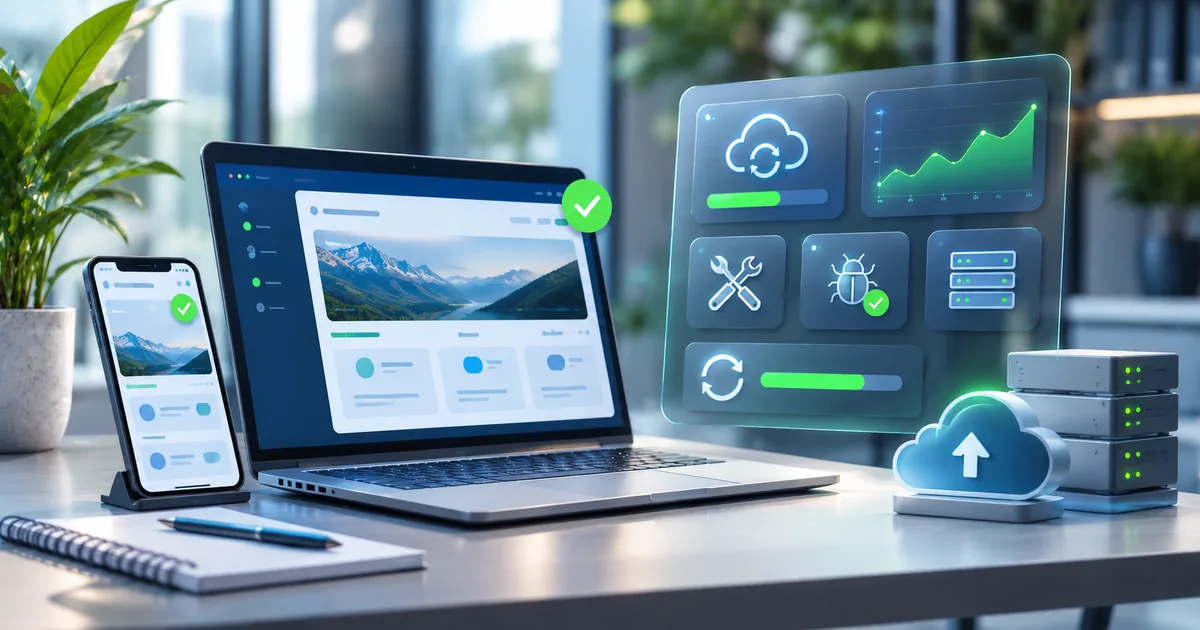
Launch day feels like the finish line. After months of planning, building and testing, getting your product in front of real users is a milestone worth acknowledging. But the moment people start using what you've built, you're in a different phase entirely, one that has different demands, different pressures and different costs than the build that came before it.
Bugs that testing never caught will appear. Users will behave in ways nobody predicted. Infrastructure that handled ten users smoothly will need attention at a thousand. Without a clear post-launch plan, the first weeks are spent firefighting instead of learning, and that's exactly the period when you can least afford to lose user trust.
This post covers what a solid MVP support and maintenance plan looks like, and why getting this agreed before you sign a development contract saves you a lot of pain later.
Why the first 90 days matter most
The first three months after launch are the most consequential stretch in an MVP's lifecycle. This is when early adopters decide whether to stay. It's when bugs and performance issues surface at a scale that controlled testing almost never replicates. It's when user feedback is most concentrated and most useful, before the initial enthusiasm fades and before habits have formed.
For founders who have investors watching or a funding round in conversation, this period carries extra weight. Early traction, or the lack of it, shapes how that conversation goes.
A team without a software support plan on day one reacts to problems instead of managing them. The difference between an MVP that builds momentum and one that stalls isn't always what was built. Often it's how fast problems got fixed, and whether the team had the capacity and structure to fix them.
What Singapore startups should expect from post-launch support
Founders based in Singapore have specific considerations that shape what good post-launch software support looks like in practice.
Operating hours and response expectations. Most Singapore-based businesses operate on a standard weekday schedule, but users don't. Consumer apps, fintech products and anything handling transactions need support coverage beyond office hours, particularly during the first weeks after launch when failure rates are highest. If your development partner's support hours don't reflect your users' usage patterns, clarify this in writing before you launch.
Cloud infrastructure and data considerations. Singapore's Personal Data Protection Act (PDPA) creates obligations around how user data is stored, accessed and retained. Post-launch support arrangements should include clarity on who has access to your production environment, where user data sits, and how access is logged and controlled. These aren't just operational questions. They're compliance questions. A software development partner in Singapore who raises these proactively is a better long-term partner than one who doesn't mention them until an issue arises.
Handover readiness. Many Singapore founders eventually bring development in-house or change partners as the company grows. Good post-launch support includes keeping documentation current, maintaining clean access controls and ensuring the product is in a state that another team could take over without months of reverse-engineering. If you're on a retainer, make sure this is explicitly part of what you're paying for.
What a post-launch support and maintenance plan should cover
A well-structured plan addresses each of the following areas with clear responsibilities and agreed response times. Vague commitments don't hold up when something goes wrong at 11pm on a Friday.
| Area | What it means in practice |
|---|---|
| Bug fixes | Severity-based response, restoration, and resolution targets agreed in the contract (e.g., target acknowledgement for critical outages with resolution or mitigation within agreed hours). |
| Monitoring and uptime | Error tracking tools configured, alerts routed to actionable engineers, and defined on-call coverage for business-critical functions. |
| Security and dependency updates | Core frameworks, OS libraries, and third-party dependencies patched on a regular scheduled cadence. |
| Hosting and infrastructure review | Ongoing reviews of cloud resource utilisation and cost optimisations as active user volume grows. |
| Backups and disaster recovery | Automated, periodically tested data backups alongside a verified disaster recovery playbook. |
| App store compliance | Tracking OS updates (iOS/Android), maintaining app store submission requirements, and renewing certificates. |
| Minor UX / feature enhancements | An optional monthly hour allocation (e.g., 10 to 20 hours as an illustrative entitlement) for quick wins and minor UX tweaks. |
Each of these should be explicitly in-scope or explicitly excluded in any MVP maintenance agreement. "We'll handle bugs after launch" is not a plan. You want specifics: who is responsible, what the response time is and what the escalation path looks like when something goes wrong outside business hours.
Maintenance vs. new features: why these need separate budgets
This is one of the most common mistakes early-stage teams make, and it creates problems in both directions.
Corrective and preventive maintenance keeps the product stable, secure, and operational. It includes bug patching, server monitoring, security updates, and infrastructure upkeep. This baseline maintenance is essential to prevent technical debt.
Feature enhancement work, on the other hand, grows the product based on user feedback and roadmap expansion. While a small monthly allocation for minor tweaks can be bundled into a support retainer, major new feature development should be managed under separate project agreements or sprint budgets.
When these two budgets get lumped together, urgent fixes push features out of the roadmap indefinitely, or roadmap pressure leaves the product accumulating risk. Neither outcome serves the business. Set up two separate line items from the start.
How to budget for post-launch support
The right budget depends on your specific product complexity. Key factors pushing costs higher include multi-platform deployments, high-frequency release cycles, tight uptime requirements, and complex third-party API dependencies.
A standard industry benchmark for ongoing software maintenance is 10% to 15% of initial build costs per year. This baseline covers core corrective and preventive maintenance (keeping the product healthy, operational, and secure), but excludes major new feature builds. Simpler single-platform MVPs may require less, while complex multi-platform systems may require more.
Ask your partner to quote a post-launch support retainer at the same time as the build itself. The teams who do have already thought about what comes after launch.
Questions to ask your development team before you sign
These questions belong at the start of the engagement, not at handover:
- Who's on call if the app goes down outside regular hours, and what is the escalation path?
- What are the contractually agreed response and resolution targets for critical, major, and minor issues?
- How are security patches and dependency updates managed, tested, and scheduled?
- How many hours per month are allocated for minor UX enhancements versus core maintenance?
- If we bring development in-house later, what does the handover package include (deployment docs, architecture notes, secrets management)?
- What is the communication channel and procedure for reporting urgent production bugs?
A post-launch rhythm that actually works
- Weeks 1 to 2: Stabilise. Check error dashboards, uptime metrics and core user flows every day. Treat critical bugs as immediate priorities. Read user feedback daily.
- Weeks 3 to 6: Prioritise. Review analytics. Identify drop-off points. Fix high-impact UX friction points and refine your product roadmap based on actual user behaviour.
- Month 2 onwards: Establish a cadence. Move to a regular fortnightly release cadence balancing bug fixes with minor enhancements.
- Every quarter: Review. Evaluate system performance, cloud infrastructure costs, and team capacity requirements.
Don't skip documentation
A product that only the original developers understand is a business risk. Documentation should be built progressively alongside the product. At minimum, ensure your maintainer provides: deployment documentation, architecture notes, environment configuration guides, and a deferred issues log.
Frequently asked questions
How much does MVP maintenance typically cost?
A standard industry benchmark is 10% to 15% of initial build costs per year for baseline maintenance. This covers operational stability, security updates, and monitoring, but excludes major new feature development.
What should a software support contract include?
At minimum: severity-based response targets, named escalation paths, security patching schedules, backup procedures, and explicit boundaries for minor enhancements versus feature builds.
What response time should I expect for critical bugs?
Target response and resolution times should be agreed contractually based on system criticality and severity levels.
What's the difference between maintenance and a support contract?
Maintenance covers keeping software healthy over time (updates, patches, monitoring). A support contract adds commitments to respond to user-facing issues within agreed SLAs.
What happens if we want to change development partners after launch?
Comprehensive deployment documentation, clean architecture notes, and sole ownership of cloud credentials allow seamless transition to a new engineering team.
Just launched, or getting close? Talk to ZI Engineering about ongoing support and fractional engineering. We work with early-stage teams across Singapore to keep products operational, secure and improving after launch.